
AI features in JKD Toolkit are a bridge. They connect the AI connector built into WordPress to our themes and our integrations, so anything of ours that wants a model has one place to ask.
On its own, the bridge changes nothing a visitor would notice. That is expected: other things run on it, and this page is the single place their setup is described.
The theme has no AI connection of its own and stores no key.
The provider and the key are configured once in WordPress, for the whole site. People often look for a key field inside the theme, do not find one, and open a ticket. There is none to find.
#What you need first
WordPress 7.0 or newer. The AI Client this is built on ships with WordPress 7.0. On an older version the theme reports AI features as unavailable, and that is the most common reason nothing works. The WordPress AI team site is where that work is published.
A provider account and key. Any provider the WordPress connector supports, with an account and credit of your own. Claude, Gemini and ChatGPT are the usual three. The key is yours and the billing is yours; we never see it and never proxy a request through our servers.
The Pro plugin with an active license. The part of the theme dashboard that uses the connection belongs to the Pro plugin.
#Setting it up
Check your WordPress version
Open DashboardUpdates. If it is below 7.0, nothing further on this page will work, and the WordPress documentation covers updating safely.
Add the provider in WordPress
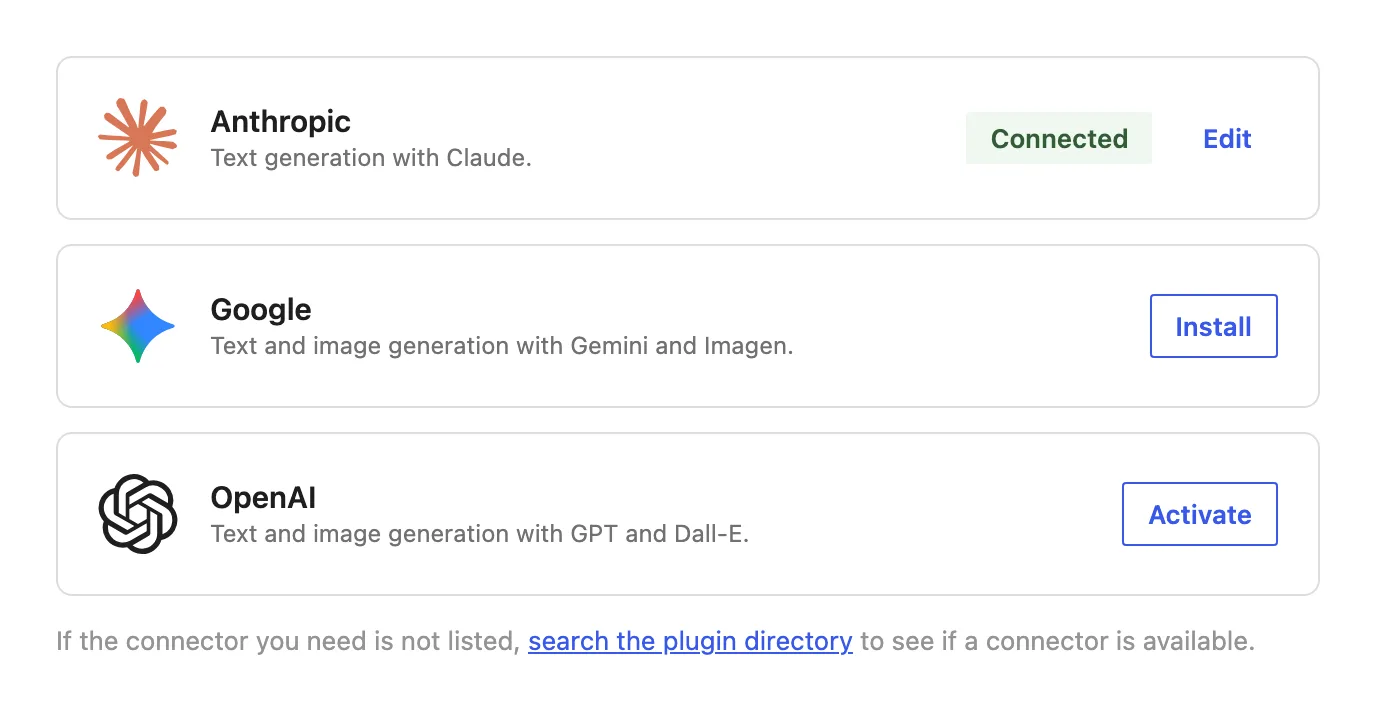
Open SettingsConnectors, pick a provider and paste the key it gave you. This is a WordPress screen, not one of ours.
Open the AI Features page
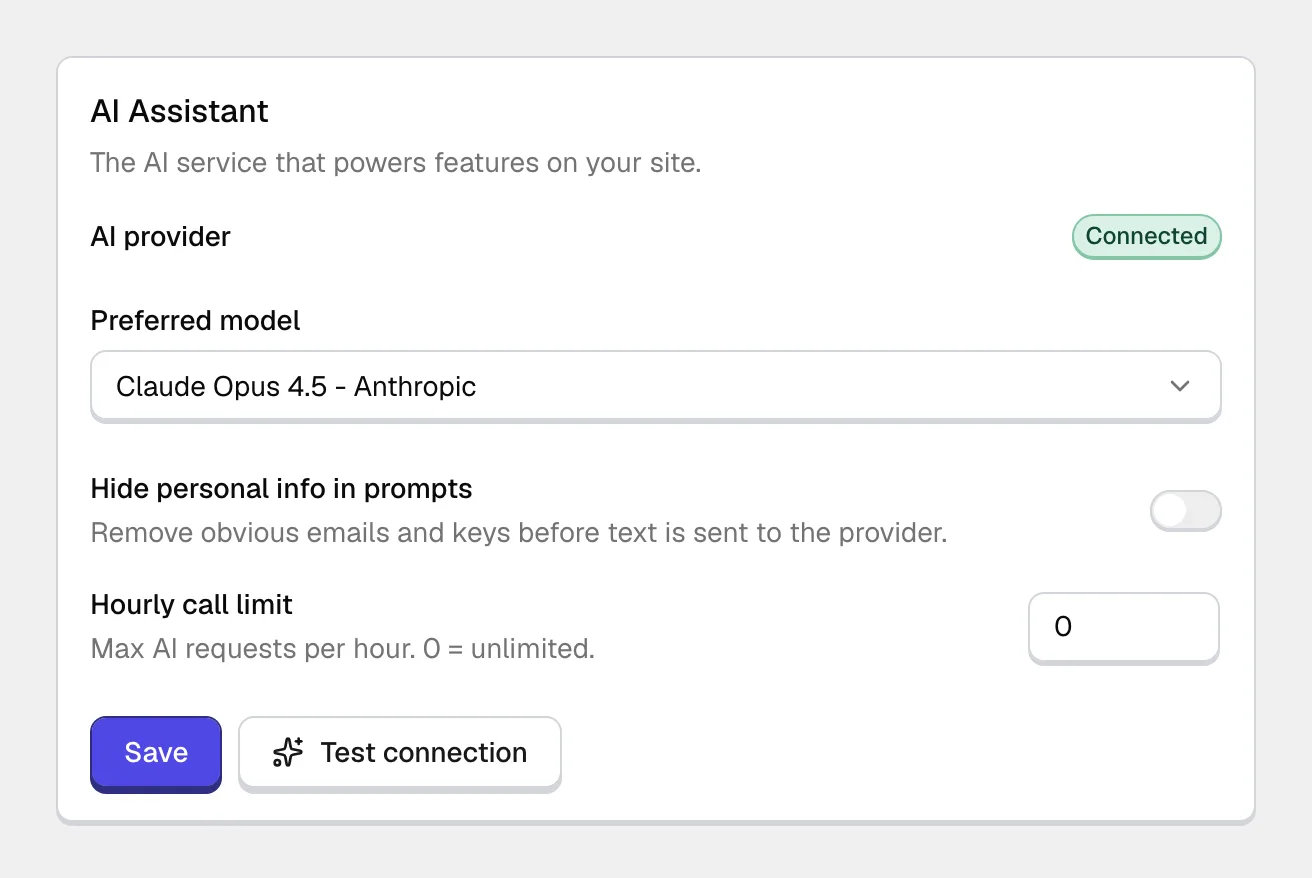
In the theme dashboard, open AI Features and switch to the Assistant tab. The AI provider row shows Connected once WordPress has a provider with a key. If it shows Not connected, the tab tells you whether the WordPress version or the missing provider is the cause.
Test the connection
Once connected, the tab offers a few guards: Preferred model, Hide personal info in prompts and Hourly call limit. Click Save if you changed any, then Test connection. If the test fails on the key, that is between you and the provider.
A provider key gives access to a paid account.
It belongs in the site settings and nowhere else. Never put it in page content, in a theme option, or in a file you commit. A key that has ever been pasted somewhere public should be rotated with the provider rather than reused.
#Why it is built this way
The reasoning here applies to any WordPress site, not only ours.
Before WordPress 7.0, every plugin that wanted a model shipped its own settings screen, its own key field and its own HTTP layer. A site running four such plugins held four copies of the same key, rotated them in four places, and had no way to see what any of them were sending. The shared connector exists to end that: the key is entered once, at the site level, and everything on the site asks the same layer for a model.
Our bridge is deliberately thin for the same reason. It adds no key storage and no provider of its own. If you later remove our theme, your AI setup is untouched, because it was never ours.
#What runs on it
The bridge does nothing by itself. It powers our integrations, and today that means one.
More will follow, and each will point back here for setup rather than describing the connector again. If an integration sent you here, the steps above are all there is to do.
#Where it fits with licensing
Integrations are licensed with the theme, not on their own.
The catalog you install them from comes with an active Pro license. A direct license includes every integration, while a Regular license bought on Envato includes only the ones marked available to Envato. They are written against our themes and expect them, so we cannot support what one does inside somebody else's theme.
#Common questions
Which AI provider do I need?
Any provider the WordPress connector supports, because the connection is made there and the theme never holds a key of its own. Pricing and limits are the provider's to publish.
It says Connected and nothing happened
That is the expected result. The bridge carries requests for other features, so the next step is an integration that uses it, and that integration has its own page.
Does this send my content to a provider?
Only what an integration asks for, when it asks. The bridge sends nothing on its own, and each integration documents what it puts in a prompt.
With Hide personal info in prompts switched on, obvious email addresses and keys are removed from the text before it is sent.
Can I limit how many requests go out?
Yes. Hourly call limit on the Assistant tab caps AI requests per hour. Zero means no limit.
Can I use it without the Pro plugin?
No. The Assistant tab belongs to the Pro plugin and needs an active license, and the integrations that use the bridge come from a catalog that needs one too.
#Still stuck
Open a support ticket and say what you tried and where it stopped. Your product, your domain, a screenshot and the exact message you saw are usually enough to settle it in one reply.
Last updated